
Quantum Superposition Explained: A Beginner’s Tour of the Quantum World
Imagine you toss a coin and, before it lands, you claim it’s both heads and tails. In everyday life, that sounds like a bold excuse for losing a bet. In the quantum world, that “both at once” idea sits at the heart of physics.
This article gives you quantum superposition explained in plain language without fake claims, without mystical fluff, and without turning your brain into Schrödinger’s cat.
What “superposition” really means (no magic required)
At its simplest, superposition means you can add states together. In wave physics, when two waves overlap, the combined wave equals their sum. That’s the classic superposition idea you see in sound and light.
Quantum mechanics keeps that mathematical structure, but it applies it to probability amplitudes, the “wave-like” quantities that determine what outcomes you can observe. Richard Feynman emphasized a key rule: probabilities come from the square of the amplitude’s magnitude.
So quantum superposition explained in one honest sentence is this:
A quantum system can exist in a combined state (a superposition) of multiple possible outcomes, and the theory lets those amplitudes interfere like waves.
The beginner-friendly picture: “both” means “a blend of possibilities”
People often say, “a particle is in two states at once.” That phrase helps, but it can mislead.
A more careful version of quantum superposition explained is:
- The system has a single quantum state.
- That state can be written as a sum of simpler “basis” states.
- When you measure, you get one definite outcome—not a half-outcome.
- The “both at once” shows up in interference and probabilities, not as two classical realities you can directly watch.
If this feels slippery, good. Quantum theory didn’t become famous for being emotionally satisfying.
The double-slit experiment: where superposition shows its teeth
If you want one experiment that screams “quantum superposition explained,” it’s the double-slit experiment. Fire particles (like electrons) one by one through two slits. Over time, the screen builds an interference pattern a hallmark of waves.
Here’s the weird part: if you set up the experiment so you can tell which slit the particle went through, the interference fades. In the standard story, the two “paths” contribute probability amplitudes that add and interfere until you force the setup to reveal path information.
That’s not poetry. That’s a repeatable lab result that modern physics takes seriously.
Schrödinger’s cat: a meme with a purpose
Schrödinger didn’t invent the cat to sell posters. He used it to point out how strange it sounds when quantum rules scale up.
Caltech’s quantum science explainer summarizes the idea: until you open the box, the cat’s fate links to a quantum event, so you describe the cat as being in a superposition of states in the thought experiment.
Important: the cat story is a teaching tool. Real cats interact strongly with their environment, which leads us to the next crucial topic.
Why don’t we see superposition in daily life? Meet decoherence
If superposition is real, why aren’t you in a superposition of “reading this article” and “doing something productive”? (No judgment.)
A big reason: decoherence. When a quantum system interacts with its environment—heat, stray fields, vibrations, even background radiation—its delicate phase relationships get scrambled. Then interference becomes hard to observe.
NIST puts it bluntly in a quantum computing context: stray electric or magnetic fields, temperature fluctuations, even a cosmic ray can ruin a superposition.
So quantum superposition explained for the macroscopic world looks like this: superposition still exists in the math, but the environment destroys the clean interference patterns that would reveal it.
Measurement: what happens when you “look”?
Quantum measurements give definite outcomes, even though the theory uses superpositions. That gap between smooth wave-like evolution and single outcomes creates the famous measurement problem.
The Stanford Encyclopedia of Philosophy describes the measurement problem as something every interpretation of quantum mechanics has to grapple with.
For beginners, keep it practical:
- Quantum theory predicts probabilities extremely well.
- A measurement returns one result.
- Different interpretations tell different stories about why that happens.
- You can learn the science of quantum superposition explained without picking a philosophical team jersey on day one.
A clean example: polarization filters (your sunglasses, but quantum)
Want a less spooky demo than cats? Use polarizing filters.
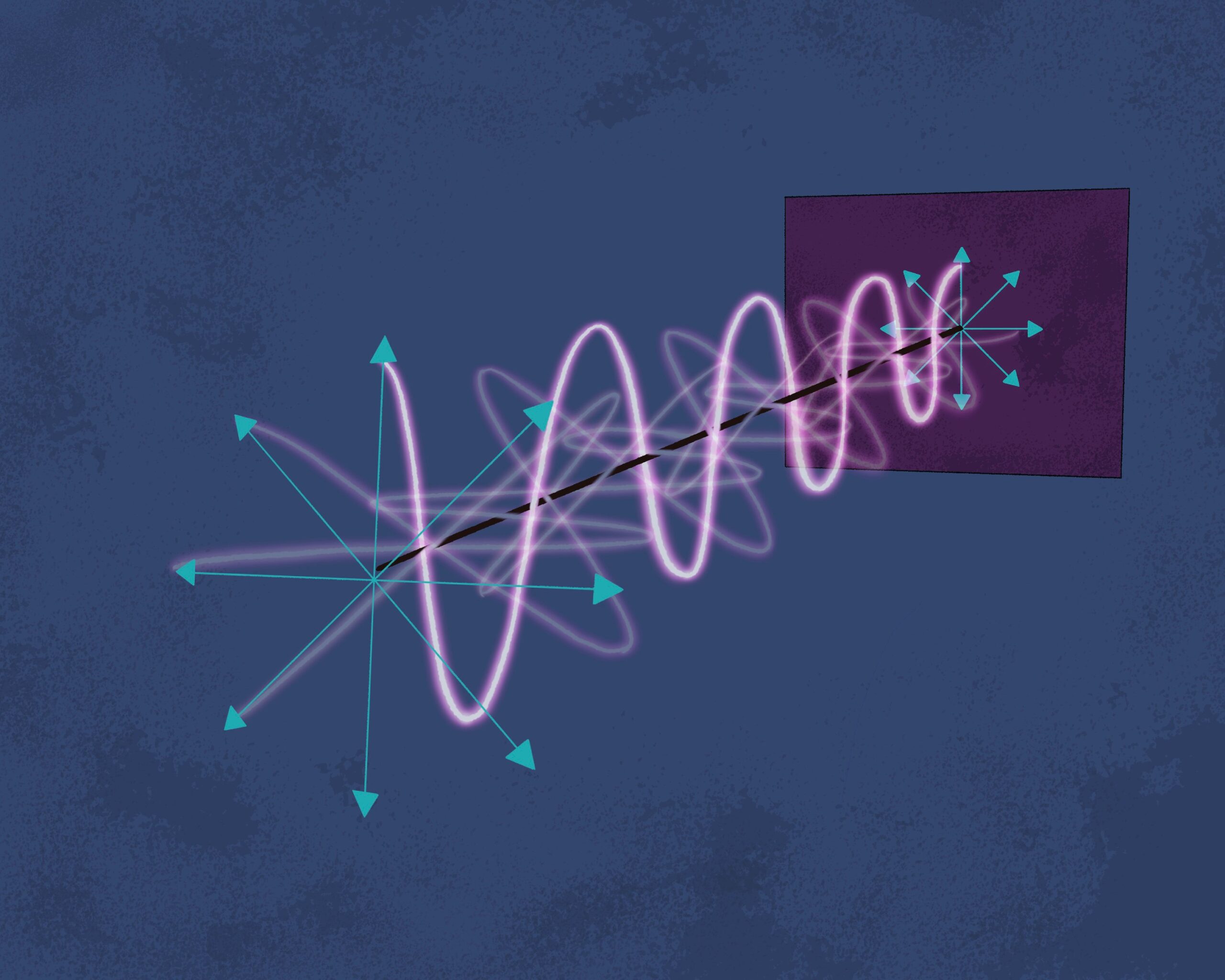
Caltech notes a classic point: if you place one filter at 0° and another at 90°, light gets blocked. But if you insert a third filter at an intermediate angle, some light can pass—because the intermediate filter changes how the polarization components combine.
This connects to quantum superposition explained because polarization states behave like quantum states: you can represent them as combinations, and the math predicts what passes and what doesn’t.
Superposition in quantum computing: why qubits matter (and what they don’t do)
A classical bit equals 0 or 1. A qubit can exist in a superposition of |0⟩ and |1⟩. IBM explains this at a high level: a qubit can store a weighted combination of 0 and 1, and combining qubits expands the space of possible states rapidly.
Here’s the key clarity for 2026 readers:
- Superposition doesn’t mean a quantum computer “tries every answer” and magically picks the right one.
- It means the computation manipulates amplitudes, and good algorithms steer interference so wrong paths cancel while right paths get boosted.
- Measurement still gives a definite output, so the trick lies in how you engineer interference before you measure.
That’s quantum superposition explained without hype.
Where superposition shows up in real technology (already)
Superposition isn’t only for futuristic computers. It already supports precision tech.
NIST explains that superposition plays a role in quantum technologies like atomic clocks, where scientists control atoms to occupy one state, another state, or a superposition of both.
That matters because timekeeping underpins GPS, telecom networks, and financial systems. Quantum physics quietly keeps your apps from arguing about what time it is.
Common myths (quick cleanup)
Myth 1: “Superposition means the particle literally splits into two classical copies.”
Not in the classical sense. The quantum state includes multiple components, and the interference shows the difference.
Myth 2: “Observation means human consciousness collapses reality.”
Standard physics does not require consciousness. The setup and interaction with measuring devices and environment matter. The measurement problem is real, but “your mind did it” is not a scientific necessity.
Myth 3: “Quantum computers break encryption tomorrow.”
Quantum computing research moves fast, but practical, large-scale fault-tolerant quantum computers require major engineering progress, including protecting superpositions from noise and decoherence. NIST highlights how fragile superposition can be in real systems.
A simple way to remember it
If you want a sticky mental model, use this:
- Classical: a system has a property you don’t know yet.
- Quantum: the system has a state that can combine possibilities, and those possibilities can interfere.
That’s quantum superposition explained in a way that stays true even after you learn more math.
What to read next (reliable sources)
If you want deeper, trusted reading, these are solid starting points:
- Caltech’s explainer on quantum superposition and why Schrödinger used the cat.
- NIST’s accessible guides to quantum concepts and why superposition is fragile in real hardware.
- Feynman’s clear rulebook on probability amplitudes and interference.
- Stanford Encyclopedia entries for the measurement problem and quantum mechanics, when you want the conceptual “why is this weird?” layer.
FAQs
1. What is quantum superposition in simple words?
It means a quantum system can be described as a combination of possible states until measurement.
2. Is superposition the same as “two things at once”?
Kind of—but it’s a single quantum state that includes multiple possibilities, not two classical copies.
3. Why does measurement change the outcome?
Measurement forces a definite result and can destroy interference that reveals superposition.
4. Why don’t we see superposition in daily life?
Decoherence from heat, noise, and the environment rapidly wipes out observable interference.
5. How does superposition help quantum computers?
Qubits use superposition so algorithms can shape interference patterns and boost correct results.
Read other articles at:https://decodeFacts.com
Previous
The Library of Alexandria: Ancient Knowledge Lost
Next