
How Dense Is a Neutron Star? The Most Extreme Real Object in Space
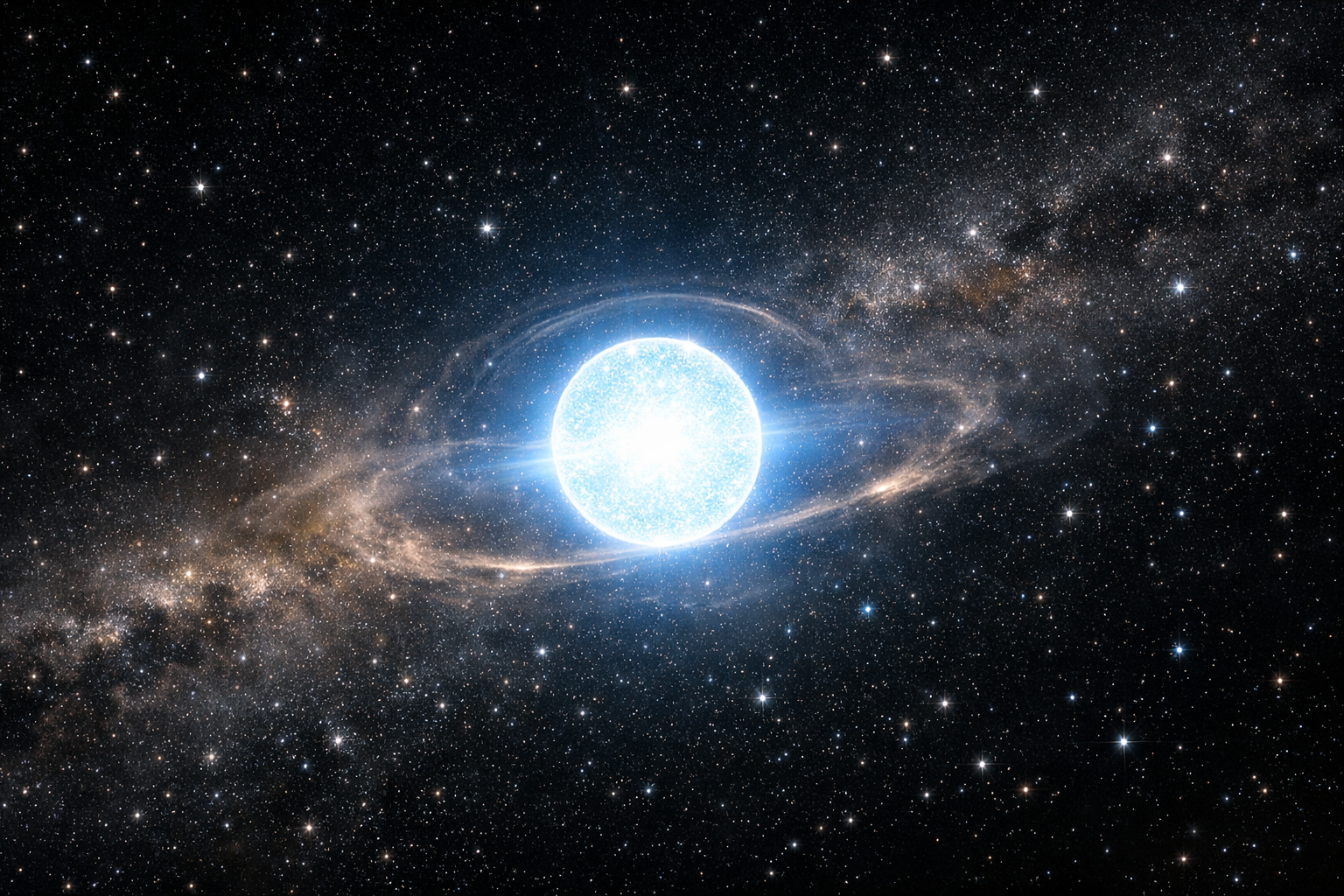
If the universe handed out awards, a neutron star would win “Most Likely to Break Your Intuition.” It looks like a small, dim star. It behaves like a physics exam written by gravity itself.
And the headline question is simple: How dense is a neutron star? So dense that even a tiny spoonful turns into a “please don’t do this at home” thought experiment.
NASA’s own explainer puts it bluntly: a teaspoon of neutron-star material could weigh billions of tons on Earth. That one line basically tells you everything and also raises about 37 new questions. Let’s answer them in a way that feels human, not like a textbook trying to bench-press your brain.
Neutron star density, in plain numbers
When people say neutron star density, they usually mean the average density: mass divided by volume. A typical neutron star packs up to about twice the Sun’s mass into a ball roughly ~20 km across (city-sized). That combination creates average densities on the order of:
- ~10¹⁷ kg/m³ (give or take, depending on mass and radius)
- That’s roughly ~10¹⁴ times the density of water (order-of-magnitude, but it’s the right scale).
If you want a “feel it in your bones” comparison, NASA and astronomy communicators often translate it like this:
- A teaspoon of neutron-star matter would weigh around a billion tons (NASA has used “a billion tons” in a NICER explainer), and another NASA/JPL page gives an even bigger figure—billions of tons—to communicate the same idea: the stuff is absurdly dense.
- Astronomy magazine uses a similar mountain-scale comparison for a spoonful.
So yes: neutron star density is not “a bit heavier than lead.” It’s “your kitchen spoon becomes a geological event.”
A quick reality check: why “teaspoon weight” varies
You might notice different numbers in different reputable sources (one billion tons, four billion tons, etc.). That does not mean anyone is making things up. It happens because:
- A neutron star’s mass can vary (some sit near ~1.4 solar masses; others push higher).
- Its radius can vary by a few kilometers, and volume depends on radius cubed (small radius changes → big density changes).
- The “teaspoon” line is a communication shortcut: it uses a typical average density, not a lab measurement from an actual spoon.
The takeaway stays the same: neutron star density sits near nuclear-density scales, far beyond anything you can hold, build, or complain about on Earth.
So what is a neutron star, really?
A neutron star forms when a massive star runs out of fuel and collapses. The star’s core crushes so hard that matter changes character. Electrons and protons combine into neutrons, and the remnant becomes a compact, ultra-dense object.
That’s why we call it a neutron star: much of it behaves like neutron-rich matter under extreme pressure. Scientists still debate the exact “recipe” in the deepest core, but everyone agrees the environment is extreme.
What makes neutron star density so extreme?
You can think of a neutron star as a victory—and a compromise—between two forces:
- Gravity, which tries to crush everything smaller and smaller
- Quantum physics, which refuses to let particles share the same state and space (degeneracy pressure and nuclear interactions)
In a normal star, heat from fusion fights gravity. In a neutron star, fusion has ended. Gravity wins most of the argument but quantum effects and nuclear forces refuse to let the star collapse immediately into a black hole.
That push-and-pull creates the “sweet spot” where neutron star density lives: unbelievably high, yet still stable (for many stars).
Layers: neutron star density isn’t the same everywhere
Here’s a useful mental model: neutron stars likely have layers, and density increases as you go down.
- Crust: a solid outer layer (yes—solid, even at crazy temperatures)
- Inner regions: matter becomes increasingly neutron-rich and exotic
- Core: physics gets weird fast; researchers test different models for what exists there
So when you read “neutron star density,” remember: it’s usually an average. The inside can get denser.
How do we actually know neutron star density?
Nobody has a neutron star sample in a vault (thankfully). Instead, astronomers estimate mass and radius, then infer density.
1) X-rays + spinning hotspots (NICER)
NASA’s NICER mission watches neutron stars in X-rays and uses their rotation to infer size. It tackles a deceptively simple question: “How big is a neutron star?”
One famous NICER result measured the mass and radius of the pulsar PSR J0030+0451 using waveform modeling. Those mass–radius constraints help narrow the “equation of state” (how matter behaves at extreme pressure), which directly connects to neutron star density.
2) Gravitational waves (GW170817 and friends)
When two neutron stars spiral together, they emit gravitational waves. Those waves carry information about how easily the stars deform called tidal deformability and that depends on internal structure and density.
The LIGO/Virgo analysis of GW170817 constrained tidal deformability, which in turn rules out some models of ultra-stiff or ultra-soft neutron-star matter. That’s a big deal: it means we don’t just guess neutron star density. We fence it in using real data.
A simple “back-of-the-envelope” density calculation (no fake numbers)
Let’s keep this logic-based and honest. If you take:
- a mass around “Sun-like” scale (often ~1–2 solar masses for neutron stars)
- a diameter around ~20 km
then average density lands in the ~10¹⁴ times water neighborhood. That matches what established references describe. The exact value shifts by star. But the scale stays stable: neutron star density is nuclear-level dense.
Why neutron star density matters (beyond trivia)
This isn’t just cosmic clickbait. Neutron star density sits at the center of a real scientific mystery:
The “equation of state” problem
Physicists want to know how matter behaves when you squeeze it beyond atomic-nucleus densities. You can’t reproduce those conditions on Earth at star-scale. So nature runs the experiment, and astronomers read the results. NICER’s radius measurements and gravitational-wave constraints both help answer: What’s inside a neutron star?
Extreme objects create extreme events
Neutron stars also power some of the universe’s wildest phenomena—pulsars, magnetars, and mergers that help produce heavy elements. (Yes: cosmic collisions help seed elements we use in phones, jewelry, and lab equipment.) Even when we focus on “density,” we’re really talking about the physics engine behind a huge chunk of modern astrophysics.
Common misconceptions (quick and friendly)
“Is a neutron star basically a giant atom?”
It’s tempting to say yes because the densities match nuclear scales. But gravity holds the whole star together, not the strong force like in a nucleus. The analogy helps, but it isn’t perfect.
“Could a neutron star turn Earth into a black hole if it got close?”
A neutron star has intense gravity, but it isn’t a black hole. Distance matters. It would be catastrophic if one came extremely close, but it won’t magically “black-hole” Earth from far away.
“Could we place a teaspoon of neutron star material on a table?”
No. Even the thought experiment ignores what would happen if you removed that material from its gravitational and pressure environment. The “teaspoon” line exists to communicate neutron star density, not to propose a dangerous new kitchen trend.
FAQs
How dense is a neutron star in simple terms?
Neutron star density is so high that a teaspoon could weigh billions of tons on Earth, depending on the star.
What is neutron star density compared to Earth?
Earth’s average density is a few thousand kg/m³. A neutron star’s average density sits around ~10¹⁷ kg/m³, so it’s roughly ~10¹⁴ times denser than water and unimaginably denser than rock.
How do scientists measure neutron star density if they can’t sample it?
They measure or constrain mass and radius using missions like NICER and use gravitational-wave data from events like GW170817 to narrow internal models.
Does neutron star density mean it’s the densest object in the universe?
Neutron stars rank among the densest known objects, but black holes go further because they represent collapsed regions where matter compresses beyond neutron-star support.
The bottom line
If you remember one sentence, make it this: Neutron star density represents matter pushed near nuclear scales—so dense that even a teaspoonful becomes billions of tons in Earth gravity.
That’s why neutron stars feel like science fiction… even though they’re completely real.
And honestly, the universe didn’t need to be this dramatic—but it clearly enjoys the attention.
Sources (trusted references used)
- NASA / JPL explainer mentioning teaspoon-scale mass for neutron star material
- NASA Goddard NICER mission explainer (formation, size, “teaspoon” comparison)
- NASA NICER mission page (mission purpose: measuring neutron star size, dense matter physics)
- Peer-reviewed NICER mass–radius inference for PSR J0030+0451 (Astrophysical Journal Letters abstract + NASA PDF)
- LIGO public GW170817 properties (tidal deformability constraints)
- APS (Physical Review Letters) on gravitational-wave constraints and neutron-star matter
- Encyclopaedia Britannica overview (size, density scale, structure notes)
Read other articles at: https://DecodeFacts.com